Cabinet refinishing & restaining · Lincoln, NE
Cabinet Refinishing in Lincoln, NE
Not every kitchen should be painted white. If you bought the house partly for the woodwork (cherry in a Near South dining room, quartersawn oak around a Country Club fireplace, a maple kitchen someone specified carefully in 2003), covering it is a decision that cannot be reversed cheaply.
Refinishing keeps the wood and replaces the failed finish over it. Doors come off to our Lincoln shop, the old topcoat is stripped, the wood is sanded back and conditioned, new stain is worked in to the colour you want, and a fresh protective clearcoat goes on. You end up with the same grain, a different tone, and a finish that has another fifteen years in it.
It is also the honest answer for a kitchen where the finish has failed unevenly: sun-bleached fronts on the west wall, worn rings at the door edges, and a clearcoat that has gone amber above the range while staying pale in the corner.
- Oak, maple, hickory, cherry, birch
- Colour matched to existing trim
- 15+ years refinishing wood
- Insured to $2M liability
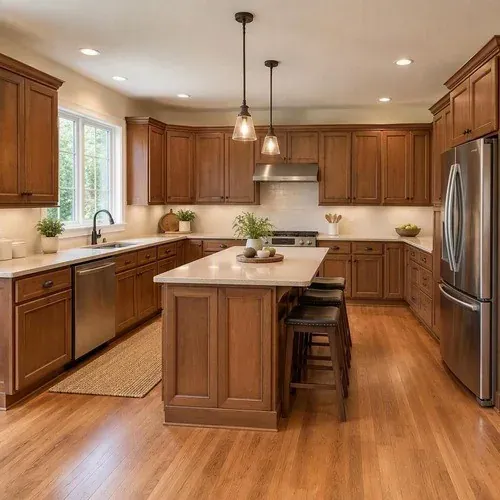
Wood Cabinet Refinishing Across Lincoln & Lancaster County
Refinishing is a slower, more skilled job than painting and it is the one we most enjoy. Paint forgives; stain does not. A blotchy patch on a maple door cannot be covered by another coat, it has to be sanded back and started again. Which is why a lot of general contractors will quietly steer you towards painting instead.
We refinish cabinets right across Lincoln and out through Lancaster County, from 1910s built-ins in the Near South to 2000s maple in the Highlands. The approach changes with the species and with what the finish has been through, which is most of what the rest of this page is about.
If you are weighing refinishing against having them painted instead, the section below is the one to read. It is a genuine fork in the road and the wrong turn is expensive.
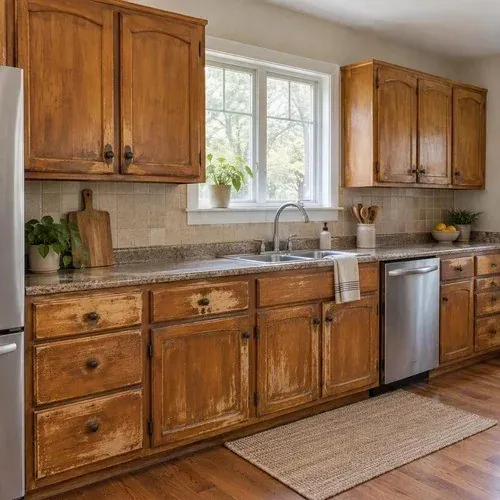
Not Everyone Wants White Cabinets
The default advice online for any dated kitchen is to paint it white. For a lot of Lincoln kitchens that is the right advice. Builder-grade oak from 1992 is not a material anybody is preserving for posterity.
But if the grain is why you bought the house, painting is the wrong call and we will say so out loud. Once paint is in open oak pores, getting it back out is slow, expensive and frequently incomplete. Once a veneered door has been sanded through at the edge, that door is finished. Painting is close to a one-way door on anything genuinely worth keeping.
Kitchen Cabinet Refinishing vs Repainting
| Refinishing / restaining | Painting | |
|---|---|---|
| Wood grain | Visible, often enhanced | Hidden |
| Colour range | Wood tones only | Any colour |
| Reversible later | Yes, can still be painted | Effectively no |
| Hides door damage | No, it highlights it | Yes, to a point |
| Typical labour | Higher | Lower |
| Typical Lincoln cost | $5,200 – $11,000 | $2,900 – $9,500 |
Two lines in that table surprise people. The first is that refinishing usually costs more than painting, which we cover below. The second is reversibility: a refinished kitchen can still be painted in ten years if tastes change. A painted kitchen realistically cannot be taken back to bare wood.
Wood Species We Restain in Lincoln Homes
Lincoln's housing stock has three fairly distinct cabinet eras, and each brought its own species.
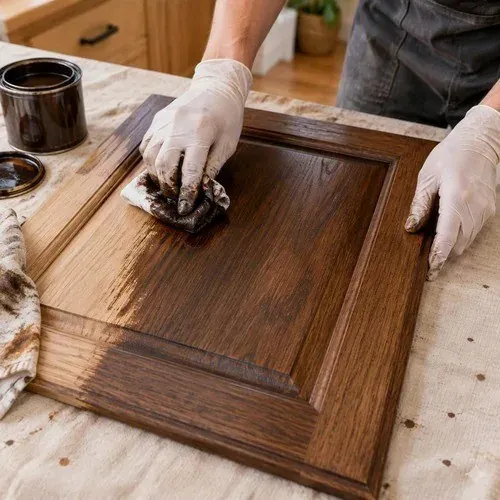
Red Oak
Red oak dominates Lincoln homes from the late 1970s through the 1990s and it is the species we see most. It takes stain readily and evenly, which makes it forgiving to work with, and its open pore structure holds colour beautifully when you are going darker.
The most common request is moving away from the orange-gold tone of the original finish. That orange is usually the clearcoat ambering rather than the stain itself, so stripping alone often gets you most of the way to a much cooler, more current look before any new stain goes on.
Maple and Hickory
Maple turns up throughout 2000s builds in Firethorn, Wilderness Hills and the Highlands. It is a tight, closed-grain hardwood and it blotches badly without a pre-stain conditioner: dark patches in the end grain and around knots that cannot be sanded out afterwards. Every maple door we do gets conditioned first, without exception.
Hickory is the wild one: dramatic colour variation board to board, from near-white sapwood to deep brown heartwood. Staining it dark flattens that variation, which some owners want and others regret. We always sample two or three doors on hickory before committing the set.
Cherry and Birch
Cherry appears in older Near South and Country Club homes and in higher-end 1990s kitchens. It darkens naturally with UV exposure over decades, so a door that has lived behind a curtain will be noticeably lighter than its neighbour. Matching that means working with the aged colour rather than against it.
Birch was widely used as a cheaper cherry substitute and behaves more like maple: closed grain, blotch-prone, conditioner required. It is often mistaken for maple until you strip it.
Where Cabinet Finishes Actually Fail
Finish failure is not random. In twenty years of kitchens it shows up in the same five places.
- The two doors either side of the sink. Constant water and constant hand contact. Usually the worst doors in the kitchen by a wide margin.
- The cabinet above the range. Heat and grease. The clearcoat here ambers faster and can go sticky.
- Door edges where rings hit. A ring on a hand catching the same spot on the same door twice a day for fifteen years wears straight through a finish.
- South and west-facing fronts. UV bleaches stain and yellows clearcoat. A west-facing run can be visibly lighter than the north wall of the same kitchen.
- Under the sink, inside. Slow leaks swell the box bottom long before anyone notices.
Spot repair works when the failure is genuinely localised and the rest of the finish is sound: a couple of doors either side of the sink, refinished and blended, is a real and much cheaper option. It does not work when the whole kitchen has ambered, because a freshly finished door beside twenty ambered ones looks worse than the original problem. We will tell you which situation you are in.
Our Cabinet Restaining Process
Assess and sample
We strip and stain two doors from different parts of the kitchen in your chosen colour, so you see the real result on your actual wood before the set is committed.
Strip the old finish
Doors come off to the shop and the failed clearcoat is chemically stripped. Face frames are stripped in place behind containment.
Sand and condition
Everything is sanded through the grits to an even surface. Maple, birch and cherry get a pre-stain conditioner to stop blotching.
Stain and wipe
Stain is applied and wiped back by hand to control depth. This is the step that decides the colour and it cannot be rushed or sprayed.
Seal, sand, topcoat
A sealer coat locks the stain, gets sanded back, then two coats of clear protective topcoat go on in the booth.
Reinstall and align
Doors return to their original openings, hinges are adjusted, and we walk the kitchen with you under a work light.
Allow eight to twelve working days for an average kitchen: longer than painting, because stripping takes time and stain needs to be worked by hand rather than sprayed. The full day-by-day version is on our process page.
What Refinishing Costs vs Painting
Straight answer: refinishing usually quotes higher than painting. Here is why, before the number arrives.
| Kitchen size | Doors + drawer fronts | Refinishing range | Painting, for comparison |
|---|---|---|---|
| Small / galley | Up to 20 | $3,800 – $5,600 | $2,900 – $4,200 |
| Average Lincoln kitchen | 24 – 34 | $5,600 – $8,900 | $4,200 – $6,800 |
| Large with island | 36 – 48 | $8,900 – $12,500 | $6,800 – $9,500 |
| Spot repair, 2–4 doors | n/a | $650 – $1,400 | n/a |
Stripping is the reason. Removing a failed finish without damaging the wood underneath is slow hand work, and it has to be complete. Any residue left in the grain shows through the new stain as a shadow. Painting skips all of it, because paint covers rather than reveals.
We would rather you knew that before the quote lands than felt ambushed by it. Full pricing across all six services, side by side, is on the cabinet painting cost page.
Cabinet Refinishing FAQs
Is it cheaper to paint or refinish cabinets?
Painting is usually cheaper, typically by fifteen to thirty percent on the same kitchen. Refinishing requires stripping the old finish completely before anything else can happen, and that is slow hand work. Painting goes over a scuff-sanded surface. We publish both ranges side by side so you can see the gap before you commit either way.
Can you take dark cabinets back to a natural tone?
Going lighter is much harder than going darker, and we will be honest about the ceiling. Stripping removes the topcoat and most of the stain, but stain that has penetrated deep into open oak pores does not fully come out. Going from espresso to a true natural blonde is usually not achievable. Espresso to a medium honey usually is. We will sample a door before quoting so you can see the realistic outcome rather than the hoped-for one.
Can you fix water damage under the sink?
It depends what has swollen. Solid wood face frames and doors can usually be dried, repaired and refinished. Particleboard or MDF box bottoms that have swollen and crumbled cannot be repaired and need replacing. That is a common single-box replacement that we handle as part of the job. We will show you which you have at the estimate.
Can you make my cabinets darker without stripping them?
Sometimes, with a glaze or a toner over the existing finish, and it is a genuinely cheaper route when the current clearcoat is sound. The limitation is that you can only go darker, the result is less durable than a full refinish, and any existing wear or damage still shows through. It is a good option for a kitchen with three or four years of life left in it, and a poor one if you want another fifteen.
Will the new stain match my existing trim?
That is a routine part of the job and we approach it by sampling rather than by picking from a chart. We finish sample pieces against your actual trim in your actual room light, because the same stain reads completely differently under north-facing daylight and warm LED. Matching aged trim is harder than matching new, since the old finish has ambered over decades, but it is very achievable.
How long does a refinished kitchen last?
Twelve to twenty years with normal use, which is comparable to the original factory finish. The two doors either side of the sink will always wear first. A modern clearcoat is more water-resistant than what was on a 1990s kitchen, so a properly refinished cabinet frequently outlasts what it replaced.
Free estimate · colour sampled first
Request a Free Refinishing Estimate
We will sample your actual wood in your actual light before you commit to a colour. Refinishing across Lincoln, Seward, Beatrice and the rest of southeast Nebraska.
Keep reading
Related to cabinet refinishing & restaining
Kitchen Cabinet Painting
Still deciding between keeping and covering the wood
Read moreBuilt-In & Laundry Cabinets
Matching original woodwork to refinished cabinets
Read moreCabinet Painting Cost in Lincoln
Real ranges for every service, plus a door-count estimator. Nobody else here publishes a price.
Read moreOur Cabinet Painting Process
Seven stages, day by day, including the prep steps that decide whether a finish lasts.
Read moreWhere We Work
Lincoln, Omaha and southeast Nebraska, with travel range and minimum job sizes published.
Read more