Kitchen cabinet painting · Lincoln, NE
Kitchen Cabinet Painting in Lincoln, NE
Your kitchen layout works. The boxes are solid. It is the finish that has aged out: orange-toned oak, a yellowed 1990s clearcoat, or a colour that stopped being current two decades ago. Replacing the whole kitchen to fix a finish problem is the most expensive way to solve it.
We paint kitchen cabinets and nothing else adjacent to it. Doors and drawer fronts come off, get labelled, and travel to our Lincoln spray shop where they are degreased, sanded, grain-filled where needed, primed and sprayed with a two-component cabinet coating. Boxes and face frames are sprayed in your kitchen behind full containment. You get an even, hard, factory-grade finish with no brush marks and no roller stipple.
Most Lincoln kitchens are off the wall on a Monday and back together the following week. You keep your layout, your countertops and your appliances. You spend a fraction of a remodel.
- 15+ years on cabinets only
- 1,200+ projects completed
- Insured to $2M liability
- Free in-home estimates
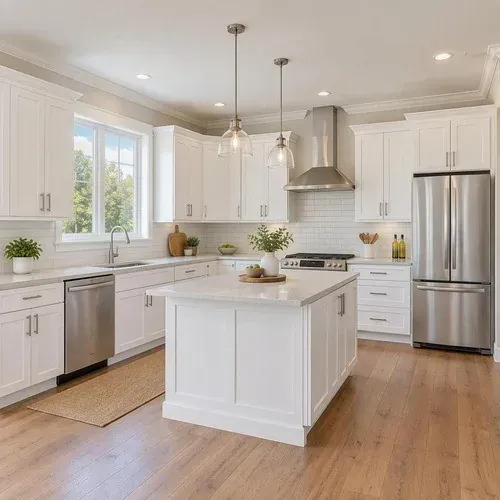
Kitchen Cabinet Painters Serving Lincoln Since 2011
When Lincoln homeowners search for cabinet painting near me, most of what comes back is general painting contractors who will spray a kitchen between exterior jobs. That is a different trade. A house painter owns ladders and roller frames. A cabinet shop owns a spray booth, a drying rack system, a moisture meter and about forty gallons of coatings that are useless on a wall.
We have been doing this in Lincoln for over fifteen years and have finished more than 1,200 cabinet projects. Kitchens are the bulk of it. That repetition is the whole argument: the hundredth set of oak doors goes through the shop faster, cleaner and with fewer surprises than the first.
- Doors sprayed off-site in a dust-controlled shop, not in your kitchen
- Two-component cabinet coatings, not wall paint and not general-purpose enamel
- Grain filling included where the door species needs it, quoted honestly up front
- Full containment of the kitchen, with dust barriers and negative-pressure extraction
- Written quote with the door and drawer count on it, so nothing moves later
If you are still deciding between painting, refinishing and new doors, the full comparison is on our Lincoln cabinet shop's main page, and what each route costs is published in full rather than hidden behind a sales visit.
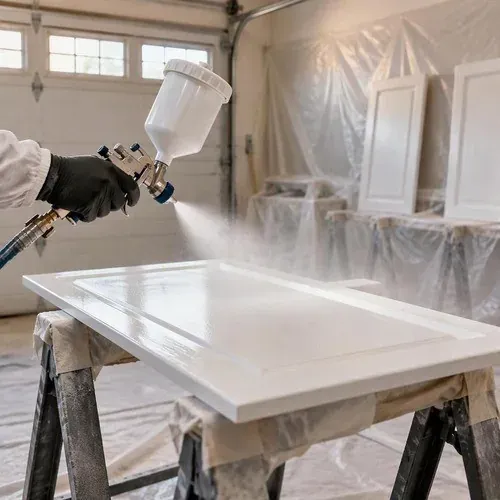
Why Repaint Instead of Replace Your Kitchen
The honest version of the maths, including the cases where painting is the wrong answer.
A full kitchen cabinet replacement in Lincoln generally lands somewhere between $18,000 and $40,000 once you count demolition, new boxes, countertop removal and refit, plumbing and electrical, backsplash repair and the flooring patch where the old footprint sat. Painting the cabinets you already have is typically a fifth to a quarter of that, and it does not put your kitchen out of action for six weeks.
It is worth doing when three things are true: the boxes are structurally sound, the layout still works for how you cook, and the door style is something you can live with. Most kitchens built in Lincoln between 1975 and 2005 pass all three. They were built with solid plywood or thick particleboard carcasses and real wood fronts, and they have decades of service left in them.
Our Cabinet Spray Painting Process, Step by Step
Seven stages, roughly six to eight working days for an average Lincoln kitchen. Nothing here is optional and nothing here is rushed.
Measure and door count
Every door, drawer front and end panel is counted and measured at the estimate. Door count is the single biggest cost driver, so putting a real number on it is what makes the quote binding.
Label, remove, and inventory
Doors, hinges and hardware come off and are numbered to their opening. Nothing is mixed between cabinets. Hinges go into labelled bags so the reinstall is an exact reversal.
Degrease
Cooking grease and silicone furniture polish are the top two causes of adhesion failure on kitchen cabinets. Everything gets a solvent wash and then a detergent wash, with particular attention to the fronts either side of the range and above the cooktop.
Sand, grain fill, repair
Surfaces are scuff-sanded to a mechanical profile. Open-pore species get grain filler worked in and sanded flat. Loose joints get re-glued, dents filled, and any water-damaged bottom rails repaired or replaced.
Prime and sand between coats
A bonding primer goes on first, then gets sanded back. This is the step budget jobs skip and it is the step that decides whether the finish is smooth at eye level.
Two finish coats
Doors and drawer fronts are sprayed flat in the shop, both faces, with a full cure between coats. Boxes and face frames are sprayed in place behind containment with extraction running.
Reinstall, adjust, walk-through
Doors go back on their original openings, hinges are adjusted so the reveals line up, bumpers are fitted, and we walk the kitchen with you under a work light before we leave.
That is the condensed version. The full stage-by-stage breakdown, including what happens on each day, is on our cabinet painting process page.
Coatings and Primers We Spray
For painted kitchen cabinets we spray a pre-catalyzed lacquer or a two-component urethane over a bonding primer, depending on the substrate and the colour. Both cure to a hard, closed film that resists the things kitchens actually do to cabinets: fingernails, water at the sink, oven steam, and the constant abrasion at the trash pull-out.
Wall paint is not a cabinet coating. Neither is general-purpose trim enamel. They stay soft for weeks, they block against each other when doors close, and they print a permanent mark wherever something rests on them. A kitchen sprayed in wall paint looks acceptable on handover day and starts failing at the contact points within a season. We will not spray one.
Colour matching to Sherwin-Williams and Benjamin Moore decks is standard, and we spray a sample door in your chosen colour before committing the full set, so you can see it in your own kitchen light.
Cure Times in a Nebraska Winter
Lincoln swings from humid August air to bone-dry January, and forced-air heating pulls whatever moisture is left straight out of the room. Both extremes change how a coating behaves. High summer humidity slows the flash-off between coats. Dry winter air speeds the surface skin but not the underlying cure, which is the trap: the door feels hard long before the film has actually crosslinked.
We hold doors in the shop through the cure schedule rather than the touch test. Reinstalling early is what leaves print marks where bumpers sit and a permanent shadow where a door closed against a face frame. It costs a day or two of patience and it is the difference between a finish that lasts a decade and one that looks tired in a year.
What Professional Cabinet Painting Includes
The visible difference between a professional cabinet job and a competent DIY or general-contractor job is almost entirely about how the coating was applied and how flat the substrate was underneath it.
Brushing and rolling leaves texture. On a raised-panel oak door with a busy profile, moderate stipple hides reasonably well. On a flat slab or a shaker centre panel, it does not. You get a fine orange-peel across a large uninterrupted plane, and it catches every bit of side light from a window or under-cabinet strip. That is the single most common complaint we hear about a previous paint job.
HVLP spraying atomises the coating and lays it down as a continuous film with no applicator marks at all. Doing it properly means removing the doors, spraying them horizontally so the film levels under gravity, and giving each coat a real cure. That is why the doors leave your house.
- Every door and drawer front sprayed both faces and all four edges
- Interiors of the boxes painted if you want them, quoted as a separate line
- New hinges and hardware fitted if you are changing them
- Old hardware holes filled and redrilled where the new pattern differs
- A touch-up kit in your finish colour left with you at handover
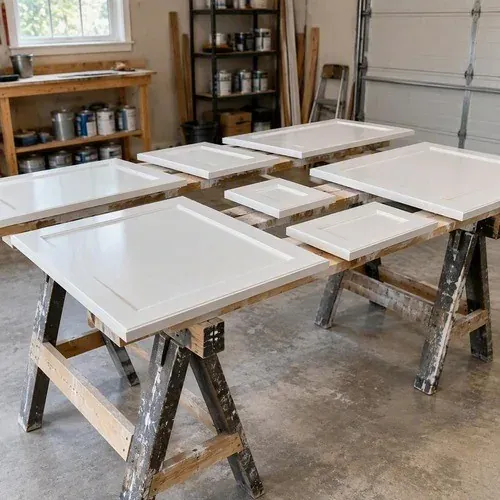
How Long You Lose Your Kitchen
You do not lose the kitchen. You lose the cabinet doors.
On day one we mask, remove the doors and take them away. From that point your cabinets are open shelving: you can reach everything, the sink and dishwasher stay connected, and the range stays usable except for the one or two days we are spraying the boxes, when the room needs to stay sealed. Most families cook through it with minor inconvenience.
An average Lincoln kitchen of 28 to 38 doors and drawer fronts runs six to eight working days end to end. Larger kitchens, full grain filling on oak, or a dark-to-white colour change can push that to ten. We give you the date the doors come off and the date they go back on before we start, and we hold to it.
Kitchen Cabinet Painting Cost in Lincoln, NE
No Lincoln competitor publishes pricing. We do, because the number is the first thing you actually want.
| Kitchen size | Doors + drawer fronts | Typical range |
|---|---|---|
| Small / galley | Up to 20 | $2,900 – $4,200 |
| Average Lincoln kitchen | 24 – 34 | $4,200 – $6,800 |
| Large or L-shaped with island | 36 – 48 | $6,800 – $9,500 |
| Large kitchen, full grain fill, colour change | 40+ | $9,000 – $15,000 |
Those are real ranges for real Lincoln kitchens, not teaser pricing. What moves you within a range:
- Door and drawer count: the single biggest factor, which is why we count them at the estimate
- Boxes or doors only: doors-only is meaningfully cheaper and works when the interiors already read as neutral
- Grain filling: open-pore oak needs it to look modern, and it adds real labour
- Dark to white: more coats, more coverage, more shop time
- Interior box painting: a separate line, commonly declined and reasonably so
- Hardware changes: new holes, filled holes, or a different bore pattern
The full breakdown, including refacing and refinishing comparisons and an interactive door-count estimator, is on our cabinet painting cost page.
Why Lincoln Homeowners Choose Lincoln Elite Cabinet Painting
Three of the seven organic results for cabinet painting in Lincoln are general painting contractors. Here is what changes when you hire a shop that does only this.
A shop, not a driveway
Doors are sprayed in a dust-controlled booth on racks, both faces, horizontally. Nothing gets sprayed leaning against a garage wall.
Coatings bought by the drum
We carry cabinet-grade primers and topcoats as stock, because we use them every week. A generalist buys a gallon for your job and guesses.
A count on the quote
Your written quote lists the exact door and drawer count it was priced against. That is what stops a number moving halfway through.
Insured to $2M
Full liability cover, and we will send the certificate before we take a deposit rather than after you ask twice.
We will talk you out of it
If your boxes are failing or your doors are the real problem, we will say so and quote the thing that actually fixes it.
One trade, one crew
The person who quotes your kitchen is on site when the doors come off. No subcontracted spray, no rotating crews.
Kitchen Cabinet Painting FAQs
Can you paint cabinets someone else already painted?
Usually yes, and it is a large share of what we do. The question is whether the existing coating is sound. We test adhesion in a few places first. If the previous finish is well bonded, we degrease, sand and go over it. If it is peeling, blistering or was sprayed over grease, it has to come off first, which adds labour, and we will tell you that at the estimate rather than after we start.
Will you paint inside the cabinet boxes?
We can, and it is quoted as a separate line so you can decide. Most Lincoln customers skip it. Interiors are rarely seen, the existing finish is usually fine, and it adds meaningfully to the cost because every shelf has to come out. If you have glass-front doors or open shelving, we would recommend doing it.
What happens while the doors are off?
Your cabinets are effectively open shelving for about a week. Plumbing and appliances stay connected and you can use the kitchen normally, except for the one or two days we are spraying the boxes, when the room needs to stay sealed and empty. We give you those dates in advance.
Do you move the appliances?
We pull the range and the dishwasher forward where we need to reach the surrounding cabinet ends, and we mask everything else in place. We do not disconnect gas or water lines. If something needs disconnecting we will tell you at the estimate so a plumber can be scheduled.
How soon can the dishes go back?
Boxes and shelves are ready as soon as we finish the walk-through. Give doors and drawer fronts a light touch for the first two weeks. The coating continues to harden after it is dry to the touch. Avoid taping anything to a painted face during that window, and do not use abrasive cleaners on it at all.
Do you paint cabinets without sanding?
No, and you should be cautious of anyone who says they will. There are bonding primers that claim no sanding is needed, and on a clean, matte, well-prepared surface they can grip. On a kitchen with fifteen years of cooking grease and furniture polish on it, skipping the mechanical profile is the most reliable way to get a finish that peels off in sheets at the handles inside two years. Scuff sanding is cheap. Redoing a failed kitchen is not.
Do laminate and thermofoil doors take paint?
Laminate and Formica take paint well with the right bonding primer, and we do a lot of it. Thermofoil is the harder case. If the vinyl film is intact and well adhered, we can scuff, prime and spray it. If it has started to lift or bubble, typically beside the dishwasher or above the oven where heat has been cooking it for years, paint will not stick it back down. On those we will recommend replacing the affected doors or looking at refacing.
Will the finish chip at the trash pull-out and the sink?
Those are the two highest-wear points in any kitchen and they are exactly why we spray a two-component coating rather than an enamel. A properly cured cabinet coating resists impact and water at those locations for years. We also leave you a touch-up kit in your colour, because over a ten-year life something will eventually get hit.
Can I keep my existing hinges?
Yes, if they are in good order. We clean them, bag them by opening and refit them. If they are worn, or if you want soft-close, this is the cheapest moment in the cabinet's life to change them because everything is already off. New soft-close hinges typically add a modest per-door cost.
Free in-home quote · Lincoln, NE
Get a Free Kitchen Cabinet Painting Quote
Send photos of your kitchen and a rough door count and we will give you a ballpark the same weekday. Serving Lincoln and southeast Nebraska, including Omaha, Waverly and Seward.
Keep reading
Related to kitchen cabinet painting
Bathroom Vanity Refinishing
Painter is already coming out; the vanity is the easy add-on
Read moreCabinet Refacing
The customer whose doors are the problem, not the color
Read moreCabinet Painting Cost in Lincoln
Real ranges for every service, plus a door-count estimator. Nobody else here publishes a price.
Read moreOur Cabinet Painting Process
Seven stages, day by day, including the prep steps that decide whether a finish lasts.
Read moreWhere We Work
Lincoln, Omaha and southeast Nebraska, with travel range and minimum job sizes published.
Read more